You spend good money on grain, hops, and yeast. You dial in your mash temperature and nail your boil. Then fermentation starts — and that’s when the smallest, cheapest pieces of equipment take over. Fermentation is the process where yeast converts the sugars in your unfermented beer (called wort) into alcohol and carbon dioxide. It’s the phase that lasts days to weeks, and during every one of those hours, your beer is vulnerable to contamination from bacteria and wild yeast that will happily ruin it. Three categories of accessories stand between a great batch and a drain pour: airlocks (one-way valves that let CO₂ escape without letting air — and contamination — in), siphons (the tools you use to transfer beer between vessels without splashing in oxygen or stirring up sediment), and sanitizers (chemical solutions that kill spoilage organisms on any surface that touches your beer). This guide breaks down how to choose each one, where it matters most, and where you can stop second-guessing yourself.
Airlocks: More Signal Than You Think, But Don’t Over-Read Them
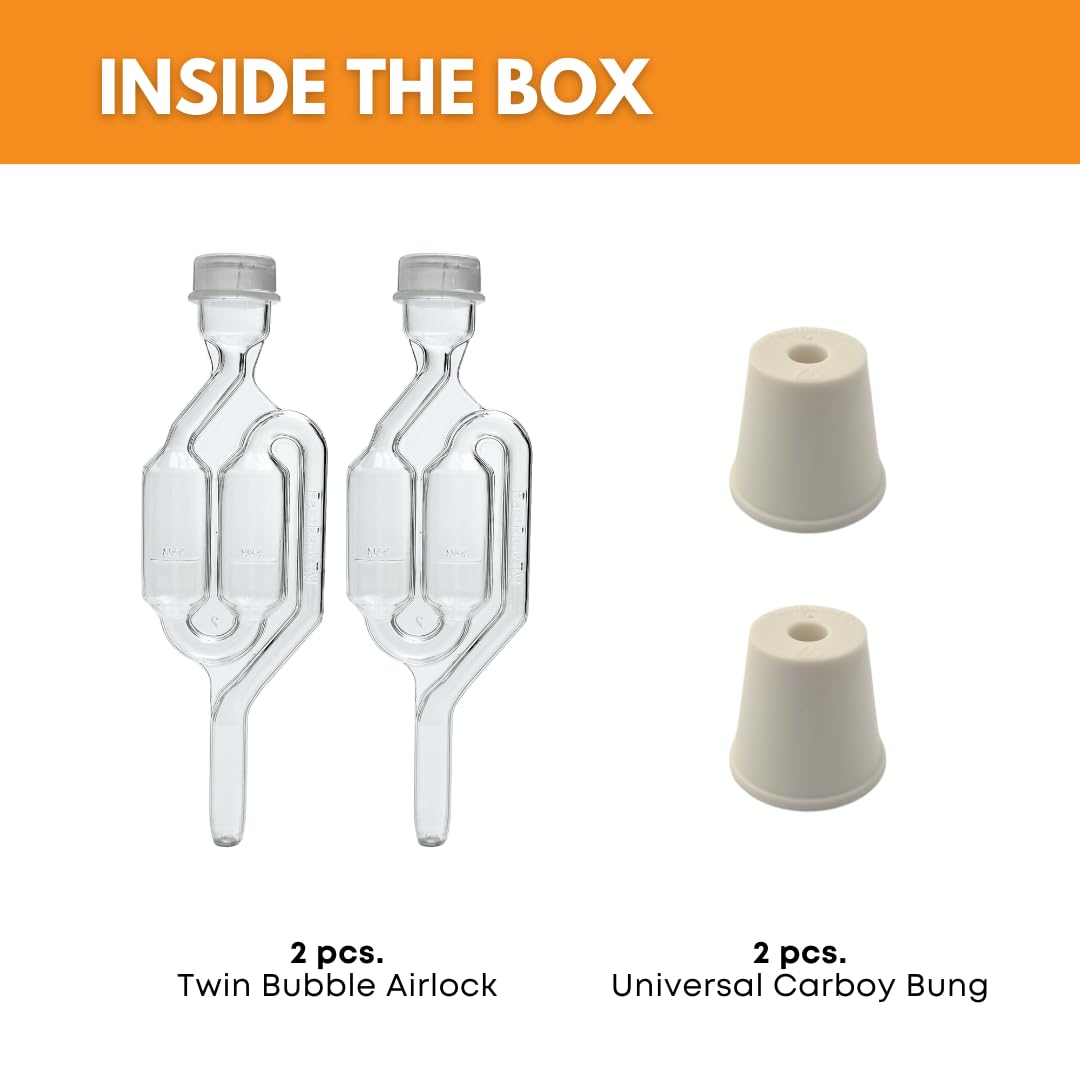
An airlock is a small plastic device you fill with a liquid barrier — usually sanitized water or cheap vodka — and fit into your fermenter’s lid or stopper. Carbon dioxide produced by active yeast bubbles out through the liquid, but outside air (and the bacteria it carries) can’t travel back in against the pressure. Simple physics, enormous protection.
There are two common designs:
- S-curve (two-piece) airlocks — the classic shape most extract kits ship with. They’re easy to monitor and easy to clean.
- Three-piece (cylindrical) airlocks — come apart for thorough cleaning, preferred by brewers fermenting anything with a lot of particulate (hazy IPAs, fruit additions) because they clog less.
Here’s the tradeoff that actually matters at your stage: don’t use airlock activity as your primary indicator of fermentation health. This is one of the most persistent intermediate-brewer pitfalls. Brulosophy’s published explainer on the topic makes this point clearly — CO₂ escapes through micro-gaps in bucket lids and loose-fitting stoppers all the time, so a slow-bubbling airlock doesn’t mean slow fermentation, and a stopped airlock doesn’t mean fermentation is done. Use a hydrometer (which measures sugar density, or specific gravity, in your beer) to confirm fermentation is complete. Use the airlock to keep contamination out. Those are its two jobs.
If you care about sealing reliability: Graduated silicone stoppers, which compress to fit multiple opening sizes, form a better seal than rigid rubber stoppers on older carboys. Owners of glass carboys in particular report that sized silicone bungs dramatically reduce the “bubbles through the lid gap” problem that makes airlock-watching unreliable.
If you care about pressure fermentation (a technique used with certain lager and kveik yeast strains where you ferment under several PSI of CO₂ pressure to suppress off-flavors), a standard airlock isn’t your tool. You want a spunding valve — a pressure-release valve set to a target PSI — installed on a vessel rated for pressure, like the Fermzilla All Rounder or a unitank from Ss Brewtech or Spike. Standard buckets and glass carboys are not rated for pressure. That line matters.
Siphons: Where Oxygen Is the Enemy
Every time you transfer beer — from primary fermenter to a secondary vessel, to a keg, or to bottles — you introduce risk. Splashing or turbulent flow picks up oxygen from the air, and dissolved oxygen (DO) in finished or near-finished beer accelerates staling. It’s the difference between a beer that’s sharp and bright at two weeks and one that tastes like wet cardboard at six.
The basic tool is an auto-siphon: a racking cane (a long tube) fitted inside a pump sleeve. One pump stroke creates enough suction to start flow without mouth-siphoning — which, besides being ineffective, introduces wild yeast and bacteria from your saliva into your beer. MoreBeer’s fermentation accessories overview explicitly lists mouth-siphoning as one of the more common contamination vectors beginners don’t anticipate.
By the numbers:
| Auto-siphon size | Fits these vessels | Transfer rate (approx.) |
|---|---|---|
| 3/8” (small) | 1-gallon and 3-gallon carboys | ~0.5 gal/min |
| 1/2” (standard) | 5–6.5 gallon carboys, buckets | ~1 gal/min |
| 5/8” (large) | 6.5-gallon+ or conical fermenters | ~1.5+ gal/min |
If you care about oxygen pickup: The step up from a basic auto-siphon is a closed transfer using CO₂ pressure. You push beer with low-pressure CO₂ (2–3 PSI) from your fermenter into a purged receiving vessel, never exposing the liquid to open air. This requires either a conical fermenter with a pressure-rated lid, or a pressure-capable vessel. Ss Brewtech Unitanks, Anvil Crucible fermenters, and Spike CF series all support this workflow. If you’re at the stage where hop-forward beers are going flat and stale faster than you expect, oxygen pickup during transfer is usually the culprit, and a closed transfer setup is the fix.
If you’re not there yet: A well-executed auto-siphon transfer, done deliberately and slowly to avoid splashing, is genuinely good enough for most styles — especially malt-forward and high-ABV beers that are more oxygen-tolerant. Don’t let perfect be the enemy of a solid process.
One practical tip that aggregated reviews of auto-siphons consistently surface: always sanitize your siphon fully assembled, including the internal pump sleeve. The gap between the cane and the sleeve is a contamination trap that gets skipped during rinsing.
Sanitizers: The Decision That Has a Right Answer
Sanitation is where the Homebrewers Association is blunt in its guidance: no-rinse chemical sanitizers have essentially replaced all other approaches for homebrewing. The reason is simple — any rinse step introduces another opportunity for contamination from your tap water or the vessel you’re rinsing into.
The two products that dominate this category for good reasons:
Star San (manufactured by Five Star Chemicals) is an acid-based, no-rinse sanitizer. You mix it at 1 oz per 5 gallons of water and it’s ready to use. Foam is contact time, not a problem — the widely-cited line from the homebrewing community is “don’t fear the foam,” and it’s accurate. At proper dilution, Star San leaves no off-flavors and kills spoilage organisms on contact. BYO’s sanitation guide names it as the baseline recommendation because it’s forgiving on contact time and genuinely effective at pH levels below 3. Owners consistently report that a batch of Star San solution stored in a sealed spray bottle stays active for several weeks if the water’s pH stays low — you can test with cheap pH strips. Hard water degrades it faster, which is a real-world limitation to know.
Iodophor is an iodine-based sanitizer also used at very low concentrations (0.5–1 oz per 5 gallons). It stains plastic over time and requires a brief drain period (not a rinse, but letting excess solution drip out). Some brewers in craft beer circles prefer it for its broader-spectrum kill rate, particularly against certain wild yeast strains. It’s the minority choice among homebrewers but a legitimate one.
What about bleach? Unscented bleach at 1 tablespoon per 5 gallons sanitizes effectively, but requires a thorough rinse, and any chlorine residue left behind will produce chlorophenol off-flavors — medicinal and band-aid notes that are virtually unfixable in the finished beer. Craft Beer & Brewing’s contamination sources overview specifically flags chlorine residue as one of the more common unexplained off-flavor causes in homebrewed batches. Use bleach for cleaning equipment that’ll sit in storage; don’t use it as your active sanitation step.
The one decision rule here: Buy Star San. Mix it properly. Use it on everything that touches your beer after the boil. That’s it. The math on this one is easy — a 32 oz bottle of Star San runs roughly $15–$20 at current 2026 pricing and makes over 160 gallons of sanitizing solution. Cost per batch is under fifty cents.
Building Your Fermentation Accessory Kit by Stage
Here’s how these decisions stack as your setup grows:
If you’re on a basic extract kit setup ($40–$120 range):
- One S-curve airlock per fermenter, filled with sanitized water
- A standard 1/2” auto-siphon
- Star San, period
Your process discipline — slow transfers, full equipment contact with sanitizer before use — matters more than any accessory upgrade at this stage.
If you’re moving into all-grain with a dedicated fermentation vessel ($300–$800 range):
- Upgrade to three-piece airlocks if you’re fermenting anything with fruit, dry hops, or high-protein grain bills that throw particulate
- Consider a silicone bung for glass carboys
- A spray bottle of active Star San solution keeps your workflow fast between steps
If you’re running an all-in-one electric system or pressure-capable conical ($800–$2,000+):
- A spunding valve replaces your standard airlock for lager and pressure-fermentation workflows
- A gas-in/liquid-out setup for closed transfers becomes the standard — this is where oxygen-sensitive styles (hazy IPAs, dry-hopped pale ales) genuinely improve
- Iodophor earns consideration if your facility handles higher volume and you want broader-spectrum sanitation coverage
The If-Then Decision Frame
The accessory category that probably feels least settled for you as an intermediate brewer is siphons — specifically, whether to invest in closed transfer capability now. Here’s the honest frame:
- If your beers taste great at two weeks but noticeably worse at six weeks, oxygen pickup during transfer is the most likely culprit. Closed transfer is the right next investment.
- If your beers have recurring medicinal or band-aid notes, audit your sanitation before buying anything. Ninety percent of the time, the fix is stricter Star San protocol, not a new piece of equipment.
- If your airlocks keep going dry or clogging, switch to three-piece airlocks and fill with vodka instead of water — it evaporates more slowly and has its own antimicrobial effect.
- If you’re planning a nano-brewery transition, build the closed transfer habit now on your home system. The documentation of your process — transfer pressures, DO pickup rates, sanitation contact times — will be expected by a licensed facility reviewer, and building that intuition on home batches is exactly the right place to start.
The small stuff isn’t glamorous, but it’s where a lot of batches are quietly saved or quietly lost. Get the chemistry right, get the oxygen out of your transfers, and let the airlock do its actual job.