Mead is, at its simplest, honey wine. You dissolve honey in water, add yeast (the microorganism that converts sugar into alcohol), and wait. No grain mashing, no boiling required, no specialized knowledge of hops. That stripped-down process is why mead is often called the world’s oldest alcoholic beverage — and it’s also why a first-time mead kit can be genuinely approachable for someone who has never fermented anything before. But “simple” doesn’t mean “easy to do well.” Honey is expensive, fermentation is slow (expect six weeks to six months depending on style), and yeast nutrition — the practice of feeding the yeast the minerals and vitamins it needs to finish the job cleanly — is where most beginner batches go sideways. This guide cuts through the kit landscape, ranks the best options from 1-gallon starter builds to 5-gallon serious setups, and gives you a clear decision frame: if you care about X, here’s the kit that fits.
| EDITOR'S PICK[Craft A Brew - Deluxe Mead Maki…](https://www.amazon.com/dp/B0F6ZR8K7H?tag=greenflower20-20) | Mid-tier[Home Brew Ohio Mead Making Kit](https://www.amazon.com/dp/B081Y612LG?tag=greenflower20-20) | Budget pickMead Making Kit – 1 Gallon Mead… | |
|---|---|---|---|
| Includes | Backsweetening & bottling tools | — | — |
| Reusable Eqpt | — | — | Reusable equipment |
| Style | — | — | Metheglin |
| Price | $79.99 | $70.78 | $49.95 |
| See on Amazon → | See on Amazon → | See on Amazon → |
What’s Actually in a Mead Kit (and What You’ll Need to Buy Separately)
Before you spend a dollar, understand what “kit” means in this category, because the word covers a wide range.
Ingredient-only kits include honey (or a honey-must blend), yeast, and sometimes yeast nutrients. You supply the vessel, airlock, auto-siphon, and sanitizer. These typically run $25–$60 and are best for someone who already owns homebrew equipment.
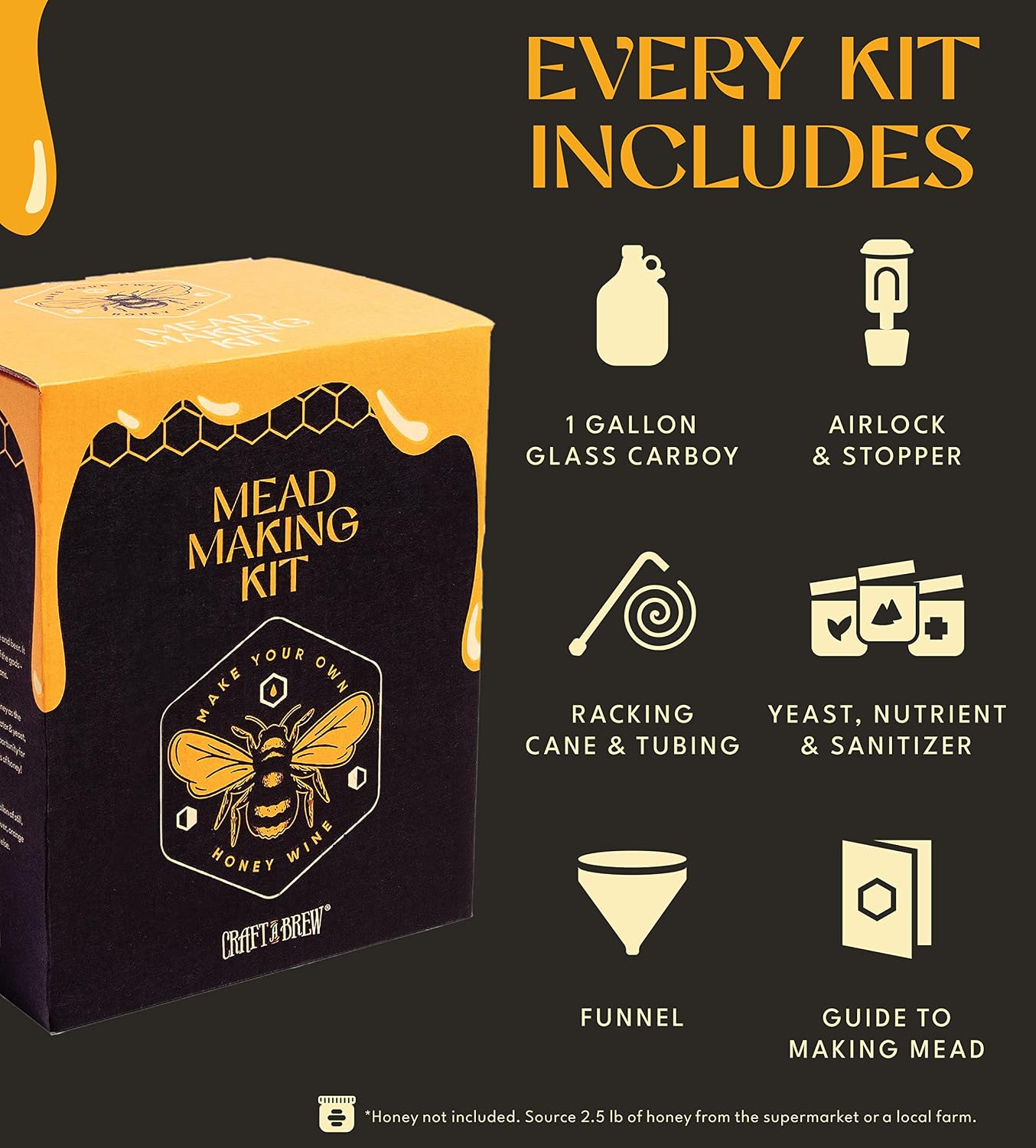
Equipment-only kits bundle a fermentation vessel (usually a 1-gallon glass jug or a 1–3 gallon plastic bucket), an airlock (the small device that lets CO₂ out without letting air in), a bung (the rubber stopper that seals the vessel), basic tubing, and a hydrometer (the tool that measures sugar content so you can calculate alcohol by volume). No honey included.
All-in-one starter kits combine both categories — vessel, ingredients, yeast, nutrients, and usually a basic instruction card. These are the most common entry point and the most common source of buyer confusion, because quality varies enormously at the same $40–$80 price point.
What almost no kit includes, even the good ones: pH strips or a digital pH meter, a proper nutrient protocol (more on that shortly), a wine thief for sampling, a second vessel for racking (transferring mead off the spent yeast), and bottles with corks or caps. Budget an extra $15–$30 for these if you’re starting from scratch.
Per the Homebrewers Association’s “Getting Started with Mead” resource, new mead makers most frequently underestimate the importance of yeast nutrients — specifically, staggered nutrient additions (adding nutrients in multiple doses during active fermentation rather than all at once) versus a single upfront dose. Kits that include a basic nutrient packet but no protocol guidance often produce mead with off-flavors or a stuck fermentation (a fermentation that stops before the yeast has consumed all the sugar). This is the single biggest quality gap between a $45 kit and a $90 kit.
1-Gallon Starter Kits: The Right Entry Point for Most New Mead Makers
A 1-gallon batch yields roughly eight to nine 12-oz bottles of finished mead. That’s enough to learn from without committing 15 pounds of honey (roughly $60–$90 in honey alone at 2026 bulk pricing) to an experiment.
The case for 1-gallon:
- Mistakes are cheap. If fermentation stalls or the flavor profile goes wrong, you’re out $15–$25 in honey.
- Turnaround is faster. A 1-gallon traditional mead (just honey, water, yeast) can be drinkable in 8–12 weeks if nutrients are managed correctly.
- Glass jugs at this size are inexpensive and widely available.
Northern Brewer’s 1-Gallon Mead Starter Kit is the most commonly cited entry-level all-in-one package in aggregated reviewer discussions. It ships with a 1-gallon glass jug, two-piece airlock, rubber stopper, packet of EC-1118 yeast (a Champagne strain known for high alcohol tolerance), and a small nutrient packet. Owners in long-run reviews consistently flag that the included nutrient quantity is a single upfront dose — workable, but not optimized for the staggered addition protocol that BYO Magazine’s “Mead Fundamentals” article identifies as the standard for clean, fast fermentation.
Brooklyn Brew Shop’s 1-Gallon Mead Kit skews more ingredient-forward: it includes honey sourced from regional suppliers (variety changes seasonally), a curated yeast strain, and recipe cards. Equipment is minimal — you’ll need a vessel. Reviewers rate the honey quality noticeably higher than generic kits, which matters more than beginners expect, because honey’s floral character is the primary flavor driver in a traditional mead.
If you care about honey quality and want to taste the terroir of the raw ingredient, Brooklyn Brew Shop’s ingredient approach is the right call, assuming you already have or can source a 1-gallon jug and airlock.
If you care about owning a complete setup with zero additional purchases, Northern Brewer’s all-in-one is the smoother start.
3-Gallon Kits: The Intermediate Sweet Spot
Three gallons is where mead making starts to feel serious. You’re producing 24–26 standard bottles, which is enough to share, age some, and actually evaluate a batch over time. It’s also the minimum batch size where investing in a proper nutrient protocol (specifically TOSNA — Tailored Organic Staggered Nutrient Additions, a methodology documented extensively in BYO Magazine’s mead coverage) starts to pay compounding dividends.
By the numbers — 3-gallon traditional mead:
- Honey required: ~9 lbs (at ~1 lb per quart of must)
- Honey cost at 2026 retail pricing: ~$45–$75 depending on varietal
- Yeast + nutrients: ~$8–$15
- Fermentation time (optimized nutrition): 6–10 weeks to dry
- Expected ABV with EC-1118 or 71B yeast: 12–15%
At 3 gallons, you’re also making equipment decisions that compound. A 3-gallon Better Bottle (PET plastic) or a glass carboy are the standard vessels. PET scratches and harbors bacteria if not replaced periodically; glass is heavier and breakable but indefinitely reusable and easier to sanitize reliably. Intermediate brewers who have already been through a 1-gallon batch almost universally upgrade to glass at this stage, per MoreBeer’s equipment overview, which notes that glass carboys remain the preferred vessel for long secondary fermentation (the slow aging phase after primary fermentation completes).
Spike Brewing and Ss Brewtech don’t produce mead-specific kits at this size, but their 3-gallon conical fermenters — designed for beer — work excellently for mead and add features like dump valves for trub removal (trub is the layer of dead yeast and protein that settles at the bottom) and temperature ports. If you’re already in the Spike or Ss Brewtech ecosystem from beer brewing, this crossover is worth noting.
A strong 3-gallon build looks like this:
- 3-gallon glass carboy (~$25–$35)
- Drilled stopper + three-piece airlock (~$4)
- Auto-siphon and 5 ft of food-grade tubing (~$12)
- Fermaid-O and Fermaid-K nutrients + DAP (the trifecta used in TOSNA) (~$18–$25 for enough to run several batches)
- Hydrometer or refractometer (~$12–$20)
- Star San sanitizer, 8 oz bottle (~$10, makes gallons of sanitizing solution)
Total build: $81–$106, not including honey.
5-Gallon Kits and Builds: The Serious Hobbyist Setup
Five gallons — roughly 48–52 bottles — is where mead making aligns with standard homebrew batch sizes, which means your existing beer equipment (5-gallon carboys, auto-siphon, tubing, bottle capper or corker) transfers directly. This is also where the per-bottle economics improve meaningfully.
The math at 5 gallons:
- Honey: ~15 lbs, ~$75–$120 retail (or $55–$90 buying from a local apiary or bulk supplier)
- Total ingredient cost: ~$90–$140
- Per-bottle cost: ~$1.75–$2.90 vs. $12–$25 for comparable commercial craft mead
The Serious Eats overview of mead production notes that premium commercial meads from established meaderies regularly retail at $18–$35 per 750ml bottle. The cost delta at 5-gallon scale is substantial for anyone making three or more batches per year.
At 5 gallons, temperature control stops being optional if you want consistent results. Yeast ferments fastest at 65–72°F (18–22°C); higher ambient temperatures accelerate fermentation in ways that stress the yeast and produce fusel alcohols (harsh, solvent-like compounds that need extended aging to mellow, if they mellow at all). A simple aquarium-style temperature controller paired with a seedling heat mat or a small chest freezer accomplishes this for $40–$80.
The 5-gallon build that makes sense for an intermediate brewer:
If you’re already set up for all-grain beer brewing, the incremental investment is low: a dedicated 5-gallon glass carboy or a spare conical fermenter, a proper nutrient kit (Fermaid-O, Fermaid-K, and DAP), a digital pH meter (~$20–$40, essential at this scale), and a temperature controller. Total incremental spend: $60–$120 on top of equipment you already own.
If you’re starting fresh at 5 gallons, expect a $150–$225 equipment investment before honey, which is the right call only if you’re confident you’ll make multiple batches. One batch rarely justifies this setup cost; three or more batches makes it look inexpensive per batch.
The American Mead Makers Association’s 2024 industry report flagged that home mead making kits are among the fastest-growing segments in the broader homebrew kit market, with 5-gallon configurations driving the majority of repeat purchase behavior — meaning, people who buy a 1-gallon kit and like the results are largely upgrading to 5-gallon builds rather than staying at small scale.
The Decision Framework: Which Kit Tier Is Right for You
Mead kit decisions map cleanly to a few honest questions:
If you’ve never fermented anything before — start with a 1-gallon all-in-one kit. The $40–$60 spend limits your exposure, and the small batch size means you’ll have finished mead to evaluate in 8–12 weeks. Don’t spend more until you’ve made one batch.
If you’ve done one or two batches and want to improve quality — the jump to 3 gallons with a proper TOSNA nutrient protocol (documented in BYO Magazine’s mead fundamentals coverage) will produce a cleaner, more consistent product than any kit upgrade alone. The technique matters more than the vessel at this stage.
If you’re already brewing beer at 5 gallons and want to add mead — your equipment transfers. Spend $25–$40 on a dedicated nutrient kit and a digital pH meter, use your existing fermentation setup, and start with a 5-gallon batch. The per-bottle cost justification is immediate.
If you’re eyeing nano-brewery or meadery territory — unitank conical fermenters from Ss Brewtech or Spike Brewing in the 7–14 gallon range, paired with glycol temperature control, are the logical next step. That’s a $600–$1,800 equipment conversation, and it’s where the hobby becomes a capital decision rather than a kit decision.
The through-line at every tier: honey quality is the variable that matters most and that no kit controls for you. Buy the best honey you can source locally — raw, varietal honey from a regional apiary consistently outperforms the blended supermarket honey included in most ingredient kits, and it’s the single upgrade that improves every batch regardless of your equipment tier.